Lucha Aerea: a style of lucha libre that is prominent in Mexico and Japan. Know as high-flying wrestling in North America, lucha aerea is fast-paced and dangerous. In Mexico, wrestlers that practice this style of wrestling are often called voladores (fliers). Voladores are small in stature and physique, choosing to develop the muscular mass of small gymnast rather than a large body-builder (as is typical in North American wrestling).Luchador Mil Mascaras is known internationally as one of the greatest fliers, a title that is non-withstanding in Mexico, where his flying skills are lack-luster, compared to many other great luchadores. Currently wrestler, Luis Ignascio Urive Alvirde, is one of the most popular voladores in the world, having wrestled in Japan as Komachi, in Mexico as El Mistico, and most recently in the United States (through the WWE) as Sin Cara.
Lucha de Cuerdas: literally, wrestling of the ropes, lucha de cuerdas is a style of lucha libre, in which luchadores use the ropes of the ring for leverage in a match. Cuerdas (ropes) may be used to bounce off of during an aerial move or to hold on.
Ras de Lona: literally, on the level of the canvas. Ras de lona wrestling, is a style of lucha libre that is caracterized by its heavy use of candados and castigos. Visually it is reminicient of Greco-Roman wrestling. Its name comes from that fact that much of this wrestling happens on the floor (hence on the level of the canvas). Additionally, Ras de Lona is a television show featuring news from Mexico's CMLL empresa.
Pique: a heated feud between two luchadores. Piques will usually warrant media attention, and thus are a great way for promotores to push the careers of a luchador. Most piques will end with a lucha de campeonato or a lucha de apuestas (although sometimes the pique will be extended if it proves to be popular by allowing the loser to get his revenge match. Piques will sometimes prove to be so popular that careers will be built around this. Famous piques include, El Santo and Blue Demon, trios Los Brazos and Los Villanos, and recently Los Psycho Circus and Los Perros del Mal.
Screen-caps from the infamous end of the Brazos vs Villanos pique, in which three Brazos lost their masks in a single match--something unheard of to this day.
Padrino: Spanish for Godfather, in the context of lucha libre, a padrino is the luchador that sponsors or mentors a new wrestler (though not always) through during his first match as a professional. A padrino will most often present a new luchador with his equipo and his mask, if he wears one, (though he did not necessarily purchase it) as a gesture of welcoming him to professional lucha libre-- this ritual is known as the bautizo (baptism).
Who a padrino is varies, but it is regularly accepted that a padrino for a new wrestler will most often be the wrestler with whom he fights his first match, most often a veteran wrestler*. However, a padrino may also be a maestro who acts as a mentor outside the ring, or the parent of a luchador who chooses to to wrestle as a junior (ex: the padrino for Rayo de Jalisco Jr. was his father Rayo de Jalisco Sr.)
Magnus making his debut luchistico
*Editors Note: During my time in Mexico, a luchador who had only been wrestling for under a year shared with me his story of his bautizo and his first match. He mentioned that his padrino was not a veteran wrestler, but rather his cousin who was making his professional debut in the same match as him. In this case, the padrino was not someone who had mentored the luchador, but rather someone who had trained with him from the beginning.
Second: a term used in both context of lucha libre and boxing for a ring-side manager. In lucha libre seconds will most often be present during luchas de apuestas or campeonato matches. A second's purpose, is mostly for the benefit of the theatricality of lucha libre while trying to add to the legitimacy of the spectacle by evoking the actual legitimacy of boxing. Seconds will walk around with a towel to wipe the sweat of their luchadores and will give them advice as they huddle in the esquinas of the cuadrilatero. More than anything, a second is there to provided moral support during the matches that he or she is present in. The presence of a second in a match hints at a longer more grueling match.
Arena: a common location where lucha libre matches take place. The most famous of the arenas in Mexico is la Arena Mexico, also known as "La Catedral de la Lucha Libre,"located in Mexico City. La Arena Mexico has space for 16,800 fans, although arenas vary from size to size. Other famous arenas include, La Arena Coliseo (CMLL's oldest arena), La Arena Coliseo de Guadalajara, and La Arena Femenil (which used to only showcase luchadoras).
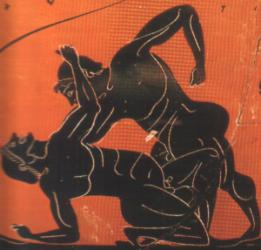
PANCRACIO: an alternative name for lucha libre regularly used by commentators during broadcasts of lucha libre matches. The term it self comes from the ancient Greek παγκράτιον (pankrátion) meaning "all powers" (pan-) "all" + (kratos) "strength, power."
A vase depicting two men fighting the pancracio style
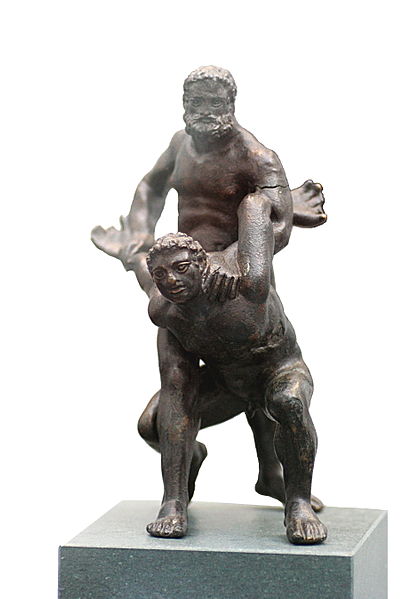
Although the rules of ancient pancracio and modern lucha libre differ, they are in many ways similar, both being contact sports that combine several martial arts into one sport.
A bronze statue depicting an ancient Greek man castigando another man using pancracio tecniques
Luchador Canek castigando Mil Mascaras using a lucha libre technique similar to the pancracio technique depicted above
Faul: pronounced "foul" and otherwise known as a low blow in English, the faul is a wrestling move commonly used by rudos. A faul is normally done by striking (most often kicking) an opponent in the groin. In many lucha libre and wrestling promotions fouling (or faulear) an opponent can warrant instant disqualification-- for this reason wrestlers will sometimes fake receiving a faul, hoping that their opponents are disqualified.
Luchador in red, faulendo wrestler in blue. and then faking a faul
Some wrestlers like El Satanico of the CMLL and Chyna during her stint with the WWF (now WWE) became known for their use of low blows during their matches, often using them as their finishing moves.
Promotor:sometimes, but not always, the owner of an empresa, the promotor is in charge of booking matches between luchadores, promoting these matches, and acquiring venues for these matches. The role of a promotor varies from empresa to empresa. In some empresas the promotor has a very minimal presence in the ring and his or her duties are mostly administrative, but in other cases as with Vince McMahon of the WWE and causually, Dorian Roldan of the AAA, the promotor will contribute to wrestling story lines and may in fact participate in wrestling matches.
Former wrestler Bobby Lashley carrying Vince (Mr.) McMahon
The most revered promotor in Mexico is Salvador Lutteroth (sometimes called the father of lucha libre); other famous Mexican promotores include Antonio Peña and his brother-in-law Joaquin Roldan.
Salvador Lutteroth (alongside Angel Blanco) in CMLL promotinal art work
Relevos Australianos: described as a match between three on three by the Lucha Libre rules of the State of Mexico, relevos australianos matches are the most common matches present in Mexican rings.
Trio Los Hijos del Averno celebrating a victory after a relevos australianos match
The basic rules of relevos australiano matches state that prior to the beginning of a match each team has to select a captain. Winning a caida in a relevos australenos match requires defeating either the team captain of the opposing team or his two non-captain team members. Additionally, the rules of this match type state that only one member of each team can be in the ring at the same time (although this rule is rarely enforced).
Trio Los Guerreros de la Atlantida, in a relevos australianos match.
Trios La Real Fuerza Aerea and Los Psycho Circus in a relevos australianos match
Trio:consisting of three luchadores, trios are a commonplace in Mexican lucha libre. Each trio has a captain, usually the more experienced of the three members of the team (but not always). Trios tend to fight in relevos australenos, although they may occasionally pick up a fourth member to complete in relevos atomicos, or may fight using other rules and match types. Sometimes, trios will be composed of brothers or other family members (as is the case with los Brazos and los Villanos), but this is not always the case.
Torneo: Spanish for tournament. Rules for torneos vary depending of the match type. Some tournaments will have wagers in which the loser will have to lose his/her mascaraor cabellera. Such is the case with a Torneo Cibernetico de la Muerte, in which two teams will face each other until only two luchadores are left, these two will face each other in a lucha de apuestas.
Some tournaments will take place over the course of one evening, while others such as the CMLL's Torneo de Parejas Increibleswill take place over several weeks. Additionally, some tournaments such as the CMLL's newly created Forjando un Idolo tournament take place over several weeks and include a point system to determine play-offs (similar to FIFA's World Cup).
A tournament bracket for the Forjando un Idolo Tournament
Other popular torneos, include the AAA's Rey de Reyes tournament. Traditionally in this tournament, 16 luchadores will fight in four way matches. Winners of these matches will advance (up a bracket system) until there are only two, these two will face each other in a final match, with the winner being crowned the champion. There is also a female version of this tournament called Reina de Reinas, in which luchadoras compete in a manner similar to their male counterparts.
The prize belt given to the winner of the Reinas de Reinas Tournament
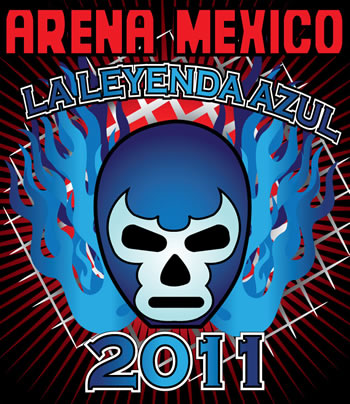
The purpose of torneos range as much as their match types, some tournaments are created to defend an existing title, while others are created to honor lucha libre leyends. The Leyenda Azul and Leyenda de Plata tournaments honor luchador legends Blue DemonandEl Santo respectively.
Promotional work for the 2011 version of the Leyenda Azul tournament
Retador: the challenger in a match. Retadores most often challenge el campeon for their titles; however, retadores are also known to challenge an opponent to make a wager in what is called a lucha de apuestas.
Relevos Atomicos: known most commonly as atomicos, are a variation match type consisting of two teams with four luchadores in each team. According to the Lucha Libre rules of the State of Mexico, in this match of four against four, two members of each team will fight two members of the opposing team on the ring while, the remaining members of each team will stay outside the ring. The winning team is the team that eliminates three members of the opposing team.
A relevos atomicos match in action. Note four luchadors (center) on the ring with remaining team members outside the ring (left).
Parejas Increibles: also known as relevos increibles, are described by the Lucha Libre rules of the State of Mexico as the modality of combining a rudo and a tecnico (as partners) while putting them up against a similar pair. Such matches are described as increibles (incredible) because of the unlikelihood of two rivals working together.
In 2010 el Concejo Mundial de Lucha Libre (CMLL) started the Torneo Nacional de Parejas Increibles. Members of this tournament came from the principal lucha libre schools in Mexico (Mexico City, Guadalajara, Monterrey, Torreon). The winners of this first installment were Atlantis (rudo) and Mascara Dorada (tecnico).
Lucha de Apuestas: perhaps one of the most interesting elements of lucha libre, the lucha the apuestas (gambling match) is a match in which wrestlers bet on the outcome of the match by wagering either his/her mascaras or cabelleras. Losers of these matches either have to unmask or shave their heads (depending on what they wagered). Upon unmasking for the first time it is not uncommon for a luchador's real name and hometown to be revealed (often these are published in local papers and lucha libre magazines). Additionally, as a form of humiliation, the loser may be force to give up his/her mascara to the winner of the match.
Silueta after being unmasked (real name revealed to be
Joanna Guadalupe Jimenez Hernandez)
Zeuxis winner of Silueta's mascara with her new trophy
Putting one's mascara or cabellera on the line against a hated opponent is a means in lucha libre to settle a heated pique between two (or more) luchadores. Though worked, because of the importance of mascaras in lucha libre, losing one's mask to an opponent is seen a source of great shame, and can at times seriously hurt the career of an newly unmasked wrestler. Luchadores who are booked to be unmasked will often be greatly compensated for their willingness to risk their careers. Many times, the newly unmasked wrestler will then in turn challenge his/her rival a second time to get his/her revenge,* but it is not unheard of for a luchador to adopt a new persona altogether; because of this, some luchadores will end up losing their masks more than once (although never as the same character).
The first lucha de apuestas occured on Sunday, July 14, 1940 at la Arena Mexico in Mexico City. In a title match match against Octavio Gaona, the defending campeon, El Muercielago Velasquez, a thin man of relatively small stature, requested that before signing his contract, the larger Gaona billed at 89kg (200 lb) would have to put his hair on the line. Octavio Gaona won the match and Velasquez was unmasked, giving rised to one of lucha libre's great traditions.
An unmasked Murcielago
Editors Note: During a luchas de apuestas I saw at the 3rd Festival Mundial de Lucha Libre in Guadalajara, both luchadores lost their masks in the same match. The match was worked in such a way that the loser got an instant rematch and his opponent as also unmasked within minutes. I would say this is pretty rare, although I am sure it has happened before.
Cuadrilatero: also known as a ring, is the space designated for a match to take place. Under most lucha libre rules, a pin may only take place inside the cuadrilatero. Some rules also stipulate that a luchador may be disqualified if he/she does not return to the ring after a countdown.
A typical four-sided ring with four esquinas (hence the name cuadri-latero)
A cuadrilatero is visually similar to a boxing ring, but is in fact very different. Contrary to popular belief the foam and canvas that cover a cuadrilatero are not soft and can often times be very hard, finding the balance between a hard and soft surface to wrestle on is crucial to preventing injuries. Notably, the three "ropes" (cuerdas) found outlining the perimeter of the ring are often not actual ropes, but instead cables wrapped in tape.
Note that the "ropes" are actually tape-wrapped cables